Privacy reform: the draft 'fair and reasonable' test reaches what your AI reads
· re: Privacy Reform: Consultation on Exposure Draft legislation (Privacy Amendment (Personal Data Protection) Bill 2026) (Attorney-General's Department)
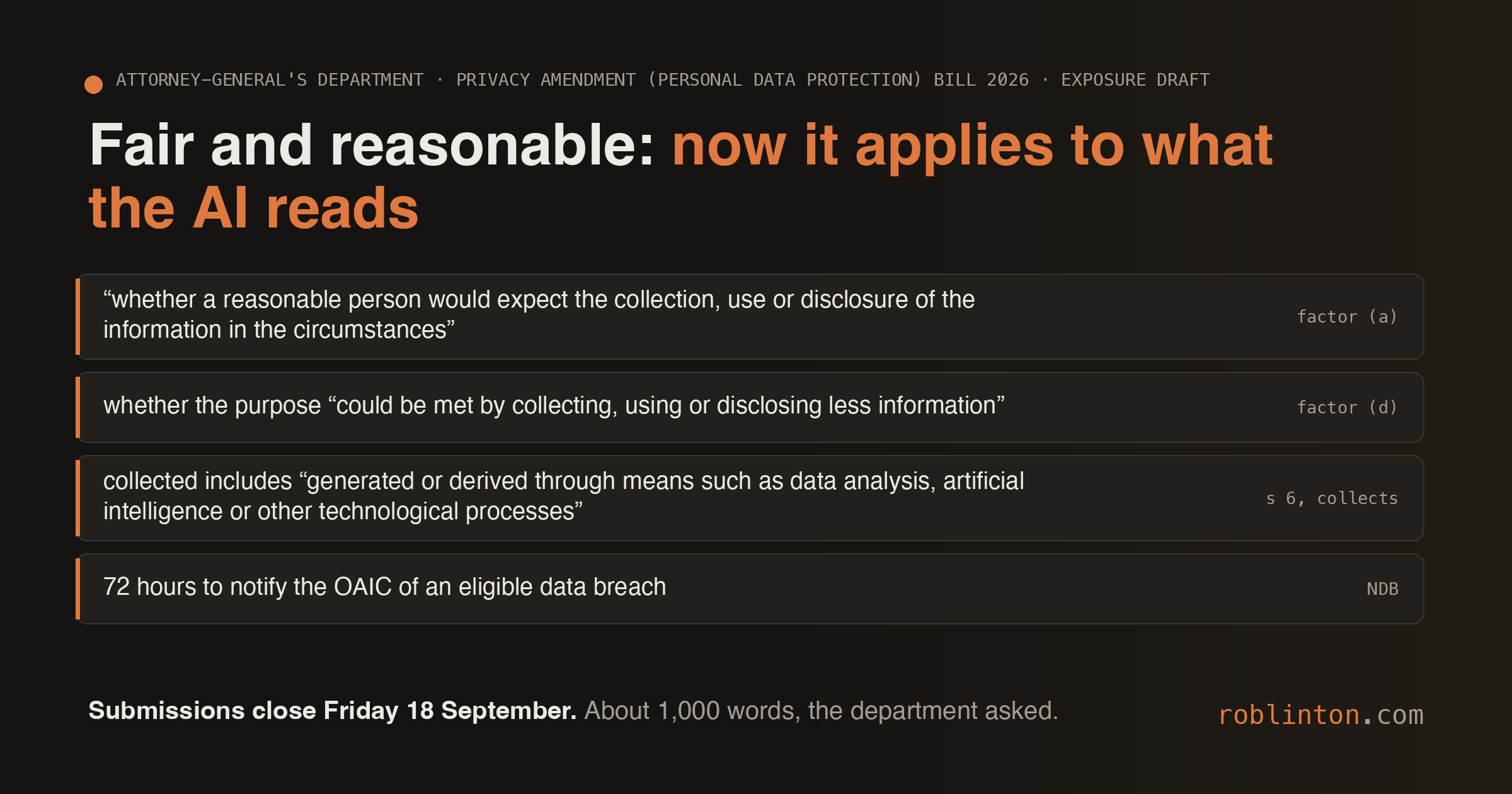
The Privacy Act’s proposed fair and reasonable test reaches what your AI reads. The tranche-two exposure draft (submissions close Friday 18 September) replaces APPs 3, 4 and 6 with one test, “fair and reasonable in the circumstances”, judged on seven factors. Factor (a): “whether a reasonable person would expect the collection, use or disclosure of the information in the circumstances.” Factor (d): whether the purpose “could be met by collecting, using or disclosing less information”. Even with consent, collecting sensitive information “will still need to be fair and reasonable in the circumstances”.
The quieter change is for AI. The amended definition of “collects” counts personal information as collected however it is obtained, including, the consultation paper says, information “generated or derived through means such as data analysis, artificial intelligence or other technological processes”. So a model’s inference about a person, once recorded, is a collection and faces the same seven factors.
My read: the draft turns “who is allowed to read this?” into a statutory question with a factor list attached. An assistant that reads everything it can reach has a factor (d) problem, and I suspect the only clean answer is a read scoped to the person asking and the purpose at hand (the design argument I have been making for some time, now with a department cover sheet).
Also in the draft: 72 hours to notify the OAIC of an eligible data breach, with an incomplete statement allowed where a complete one is “impossible or impracticable”. The current rule is “as soon as practicable”, apparently the reason most notices arrive when the lawyers are ready.
Net: no introduction date is published yet. If your AI estate cannot say what it reads and why, Friday is a good day to write that down (about 1,000 words, the department asked).