AI Data Enclaves
An AI data enclave lets staff and their AI work with the information they are permitted to see, while the organisation controls which models may process it. My MilCIS presentation covered the software components and why Australia needs local confidential GPU capacity. Sovrata will be shipping in Q1 2027.
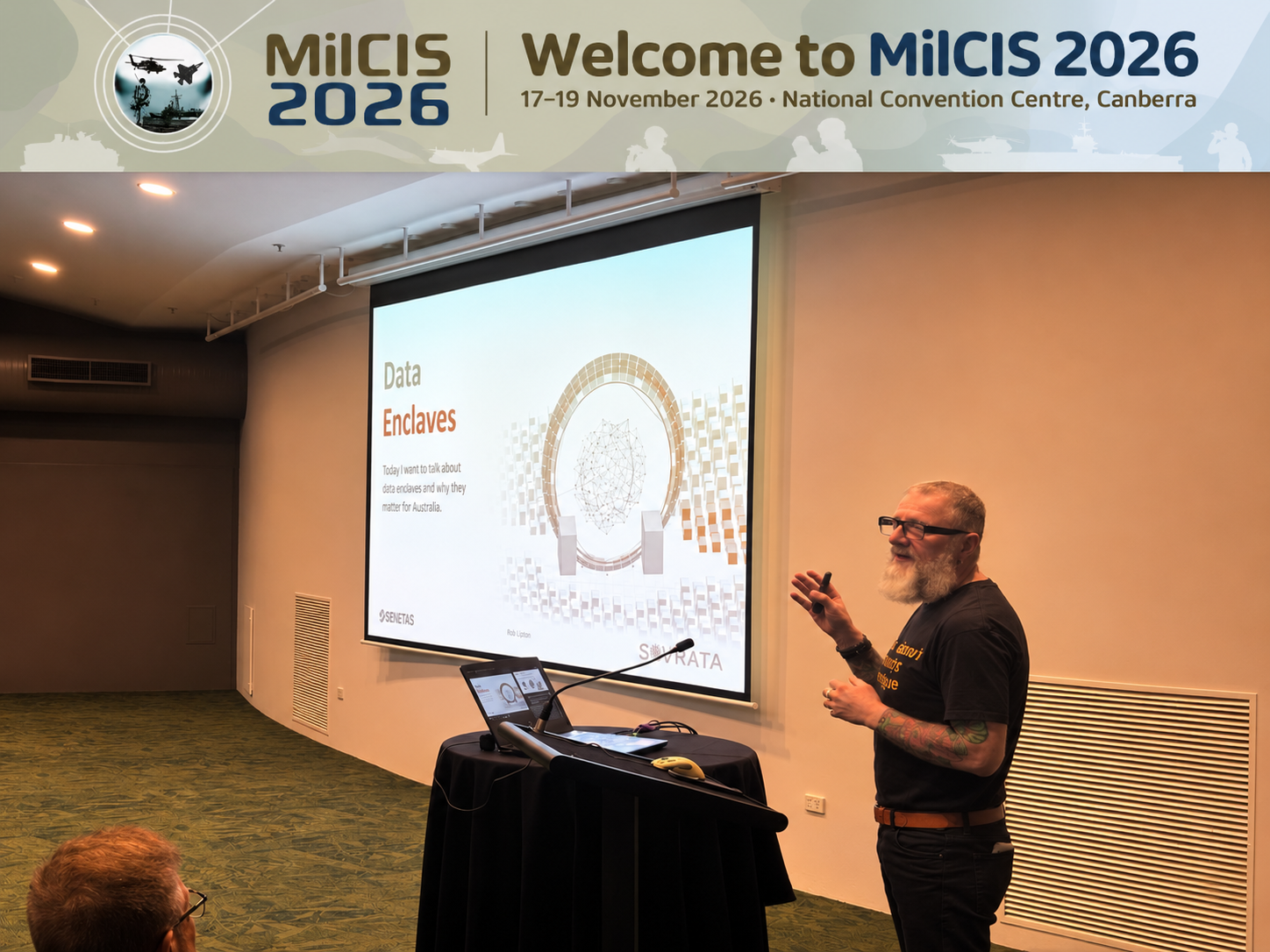
An AI data enclave gives an organisation a way to use its own information while keeping control of access and processing. Staff and their AI work with the information they are permitted to see. The organisation decides which models may receive it.
That was the argument behind my Data Enclaves presentation at MilCIS 2026 in Canberra. I walked through the components, how they fit together, and why Australia needs the infrastructure to run them locally.
Why isn’t an AI assistant an AI data strategy?
Buying an assistant leaves the organisation with decisions about its data that a licence cannot make.
Microsoft 365 Copilot uses a user’s existing access permissions. Microsoft operates the service. Those are useful capabilities, but you still have to decide which information AI may use and where it may be processed. Some work can go to an approved external service. Other work needs to stay on infrastructure you control.
As I put it in the presentation: “Ticking the Copilot box doesn’t give you an AI strategy.”
What is an AI data enclave?
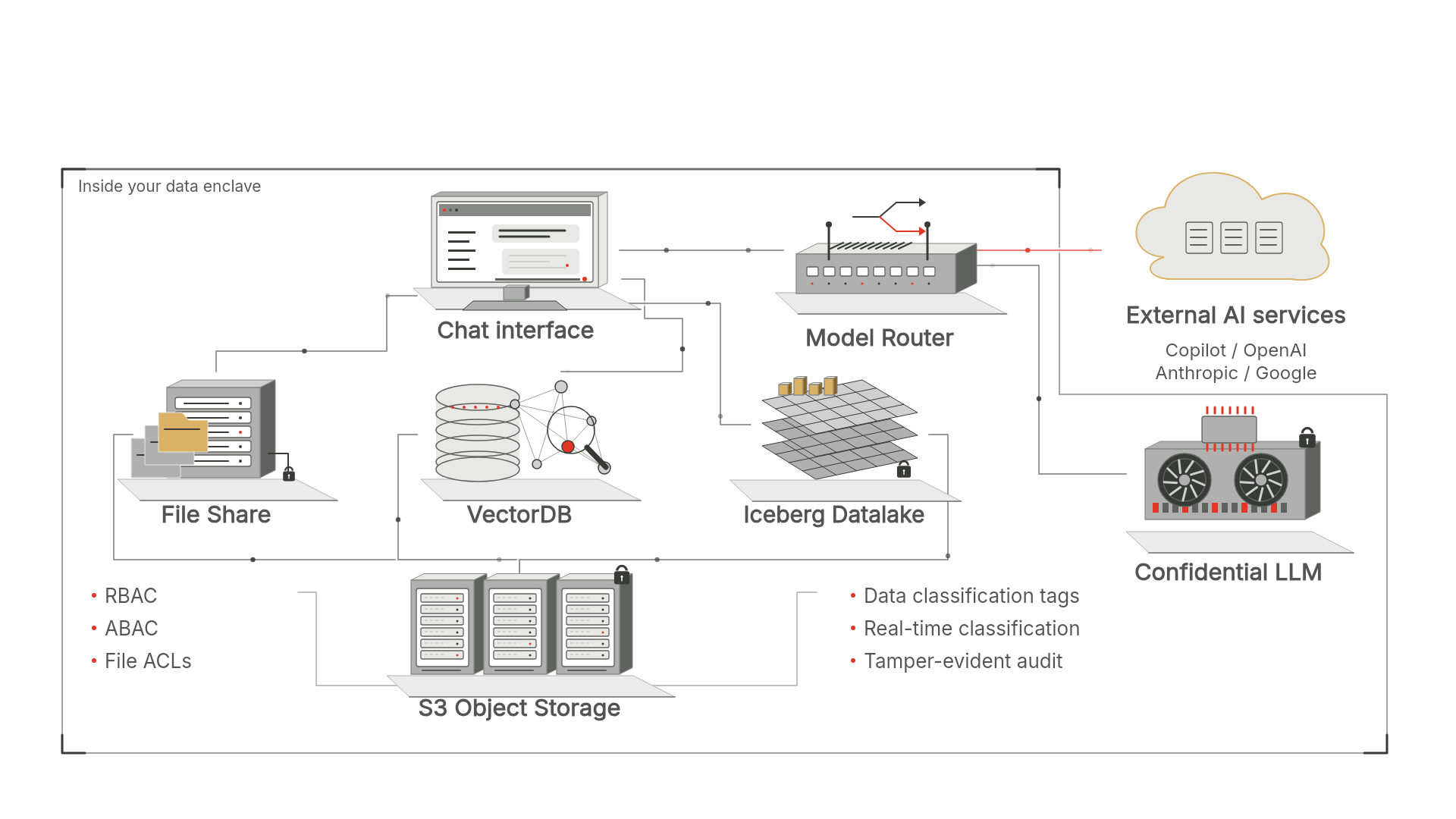
An AI data enclave brings private information and the controls for using it into an environment the organisation controls.
It can run on your premises or in your own cloud account. The data is brought into that environment. Existing file-sharing and storage interfaces can keep the familiar tools usable, while people and their AI work under the same access rules.
The access rules include roles, attributes such as clearance, file permissions and classification labels. They need to apply wherever information is read, including through AI search. An agent acting on your behalf should only see what you are cleared to see.
What goes inside it?
The presentation covered seven software components, with access controls and an audit trail across them.
| Component | Its job in the enclave |
|---|---|
| S3-compatible object storage | Hold the data that the other components use. |
| File sharing | Give staff familiar Windows SMB and Unix NFS access. |
| Iceberg-compatible data lake | Organise structured records into tables that query engines can read. |
| Vector search | Find relevant information for AI search and retrieval-augmented generation, or RAG. |
| Chat | Hold the conversation, its sources and its classification. |
| Model router | Choose a model permitted to process that conversation. |
| Private inference | Run a model on the selected compute infrastructure. |
Storage is the starting point. Files, tables and vector data need governed access, and access decisions need an audit trail that an auditor can examine. The familiar file share matters too. Staff should be able to work with their files without learning an entirely new way to open a folder.
Structured records need their own treatment. Apache Iceberg provides an open table format, with SQL access supplied by compatible query engines. The enclave still has to enforce who may read the information. Supporting a table format does not settle that question.
Can search become another way around permissions?
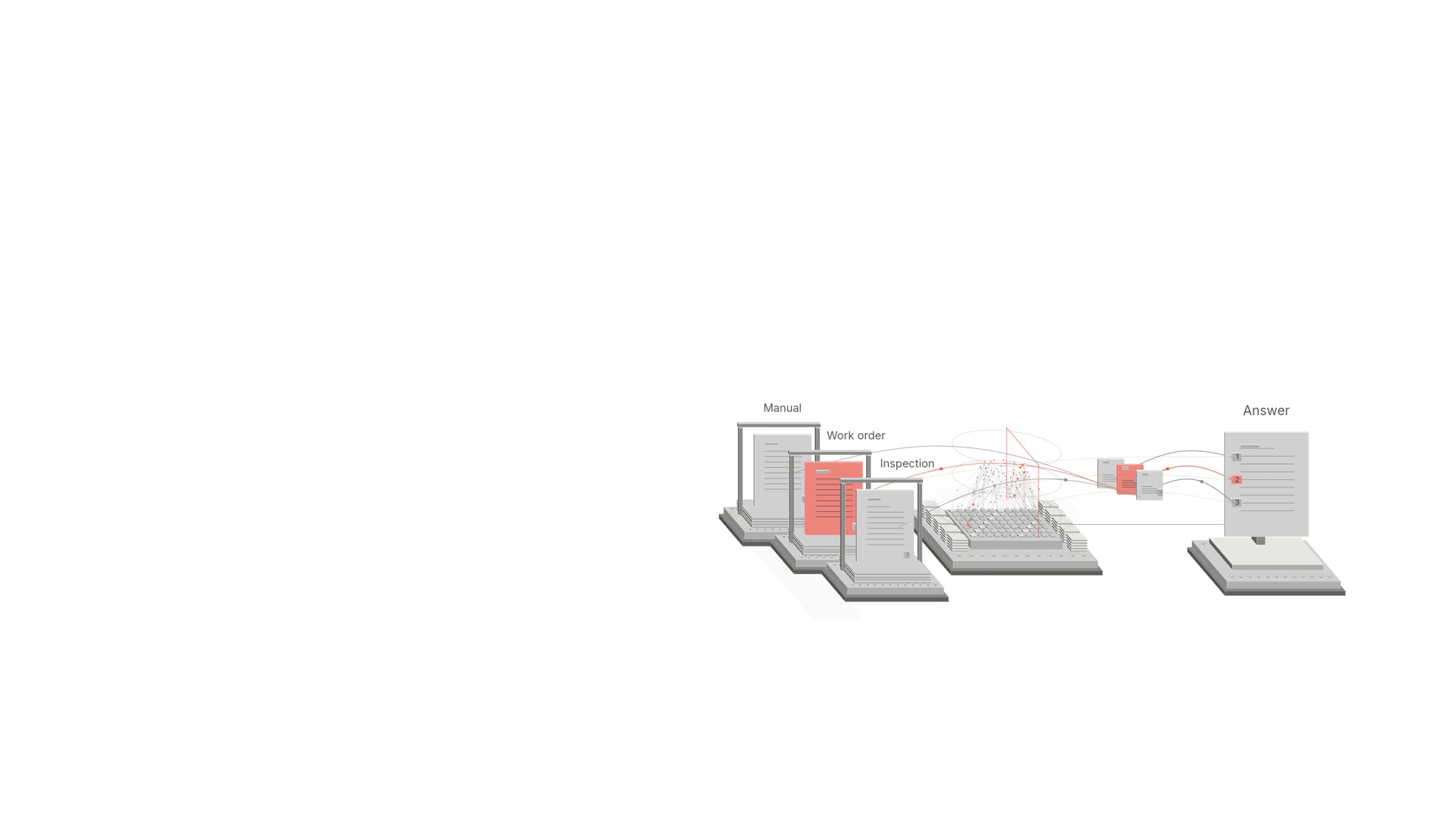
A search index must respect the permissions on the information it represents.
Putting a restricted document into an AI search index should not make its contents available to somebody who cannot open the original. That applies to the search records an agent retrieves on a person’s behalf, as well as the file itself.
The same care is needed with structured data. Being allowed to query a table should not automatically mean being allowed to read every sensitive column. Those checks belong in the system serving the data.
Why does the chat need a classification?
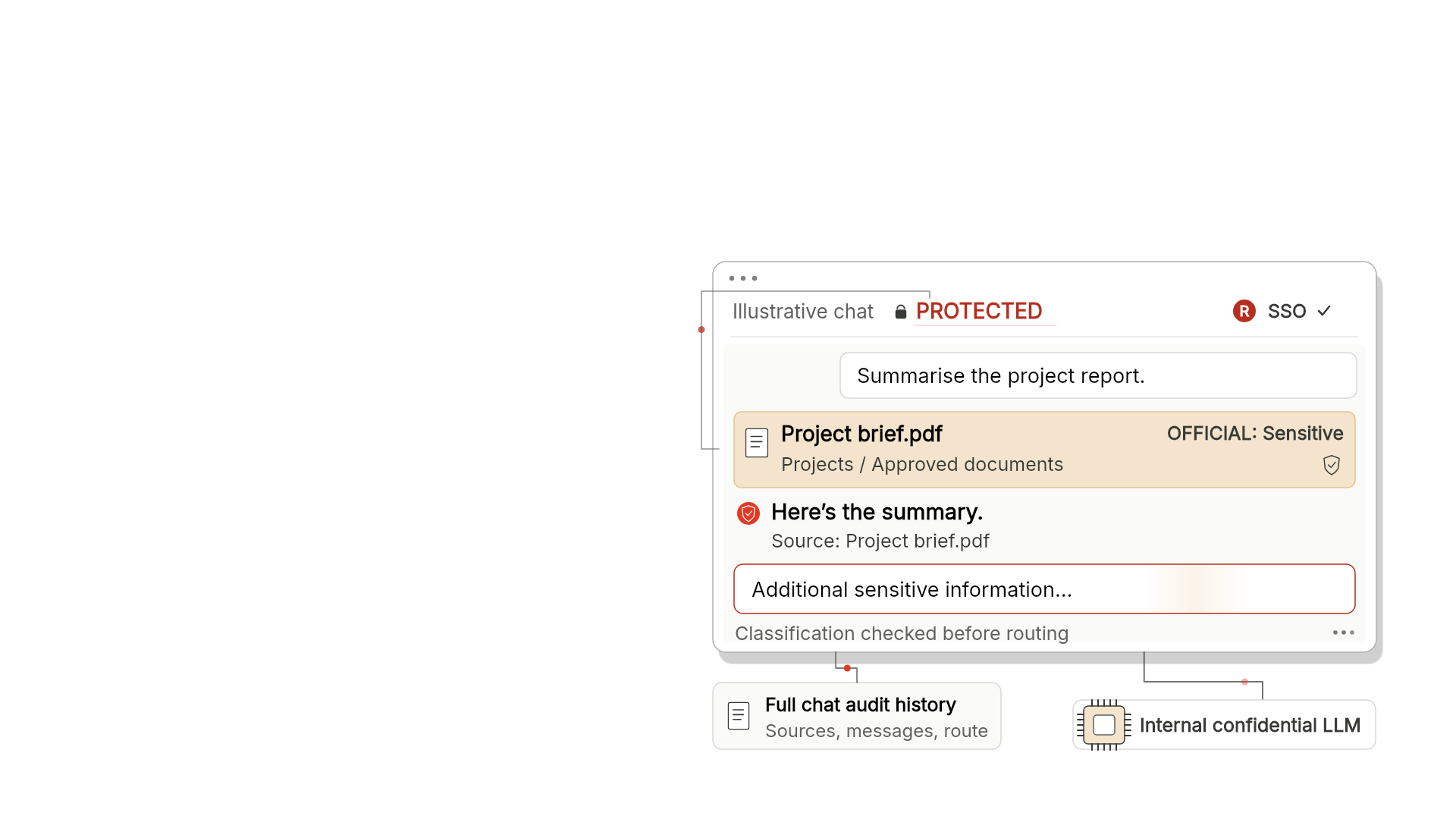
The conversation needs to reflect the sensitivity of everything it contains.
You might start with a harmless question, retrieve a restricted document, then type in something sensitive yourself. Combining several facts can also make the result more sensitive than the individual sources. You need to check where the whole conversation is now allowed to go.
(The text box is not a declassification service.)
I argued that a chat cannot remain at a lower classification than the information brought into it. The user also needs to see the sources behind an answer. Conversation history and an audit trail let you examine the access decisions and model route.
Who decides which model receives it?
The organisation’s rules and the conversation’s classification should determine the permitted model.
That decision applies to the whole conversation being sent, including retrieved material. Checking only the latest sentence misses the information already attached to it.
An approved external service may be suitable for one conversation. Another may require a private model inside the enclave. Where policy requires confidential computing and attestation, a failed check should stop the workload. It should not trigger a quiet fallback to a service that policy does not permit.
Why does Australia need confidential GPU capacity?
Australia needs local compute with verifiable protection for data while it is being processed.
You can buy the hardware or rent capacity. Renting makes it possible to use GPUs without buying the whole installation upfront, but the available security configuration still matters.
Confidential computing is designed to protect data in use. Attestation provides cryptographic evidence about the measured state of the compute environment. That evidence can be checked before releasing data or keys. Azure’s confidential GPU documentation describes this across the CPU and GPU. It does not certify the model’s answer or prove that every application permission is correct.
Australian location and protection from infrastructure operators are separate requirements. A server being here does not, by itself, establish who can inspect its processing memory. Equally, protected processing overseas does not settle Australian residency or jurisdiction requirements.
My read: we need investment in both local GPU capacity and the protections that let organisations use it for sensitive work. That is the infrastructure gap behind my argument that Australia needs more than AI-written emails.
Where does Sovrata fit?
Sovrata, the AI data-governance venture out of Senetas, brings the software components together for this kind of enclave.
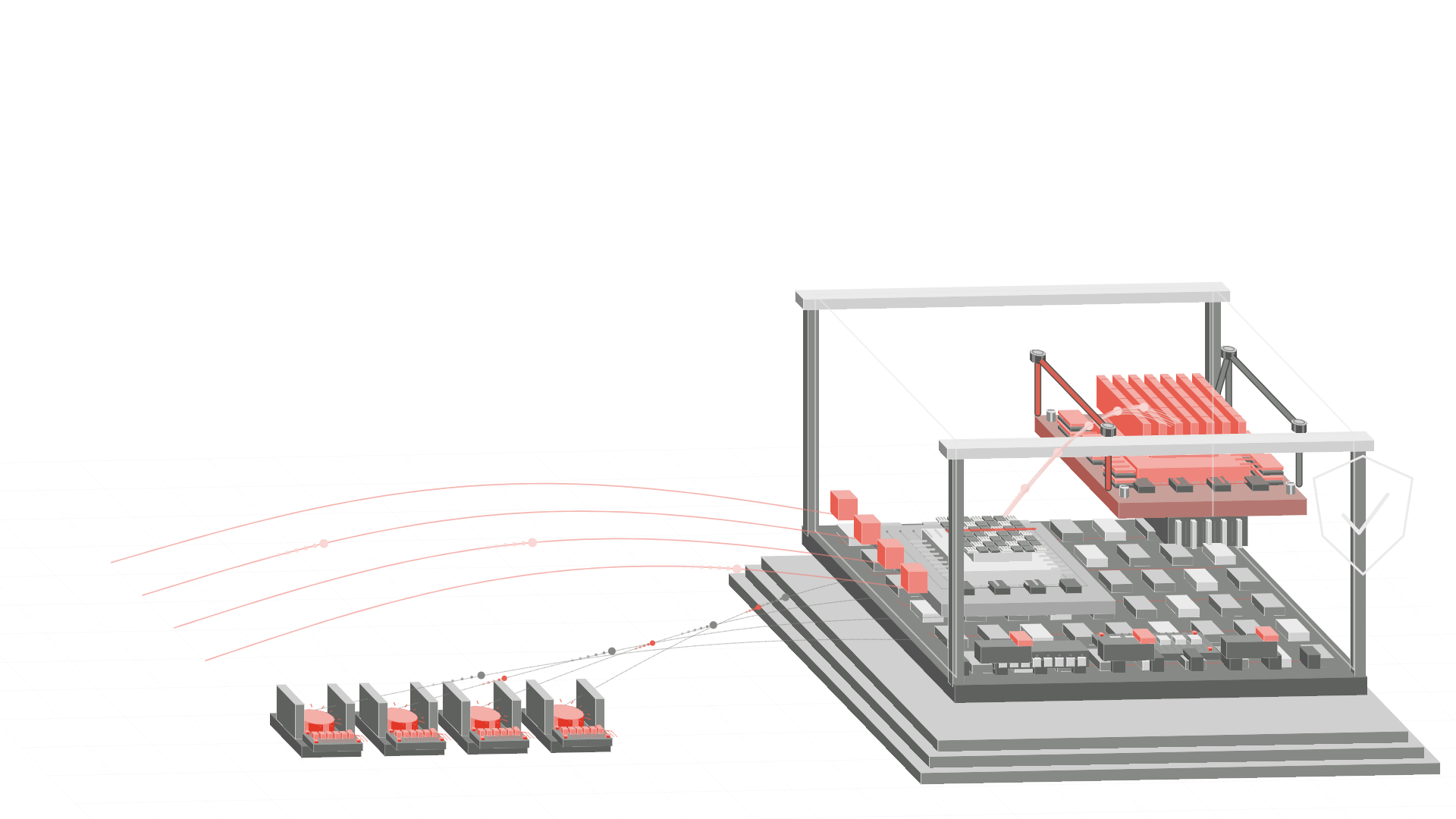
In the presentation, I mapped Storage, File, Query and Search to the data services, with Chat, LLM routing and Inference around them. The deployment can be on premises or in an organisation’s own cloud account. A local file-sharing appliance can sit with staff while the main environment runs in the cloud.
Sovrata will be shipping in Q1 2027. Senetas brings nearly three decades of supplying hardware encryptors to government and defence to that work.
My closing recommendation was to bring one real workflow and its data to a demonstration. Ask to see the access rules and approved model routes working together. That is a useful way to assess what control over your data actually means.
Be able to explain who can read the information and where the AI will process the conversation. Then ask the system to demonstrate those limits.
Sources
- MilCIS 2026 conference program · MilCIS
- Data, Privacy, and Security for Microsoft 365 Copilot · Microsoft
- Apache Iceberg · Apache Software Foundation
- Attestation · Google Cloud
- Azure confidential GPU onboarding · Microsoft Azure