GTC Berlin: Europe wants AI in its own voice
Europe wants to build AI in its own voice. That was my strongest impression from GTC Berlin: different countries with their own customs and humour, sharing a belief in open models and the ability to shape and operate their own AI. The ambition makes sense. Delivering it takes local skills and compute, as well as control of the models and data.
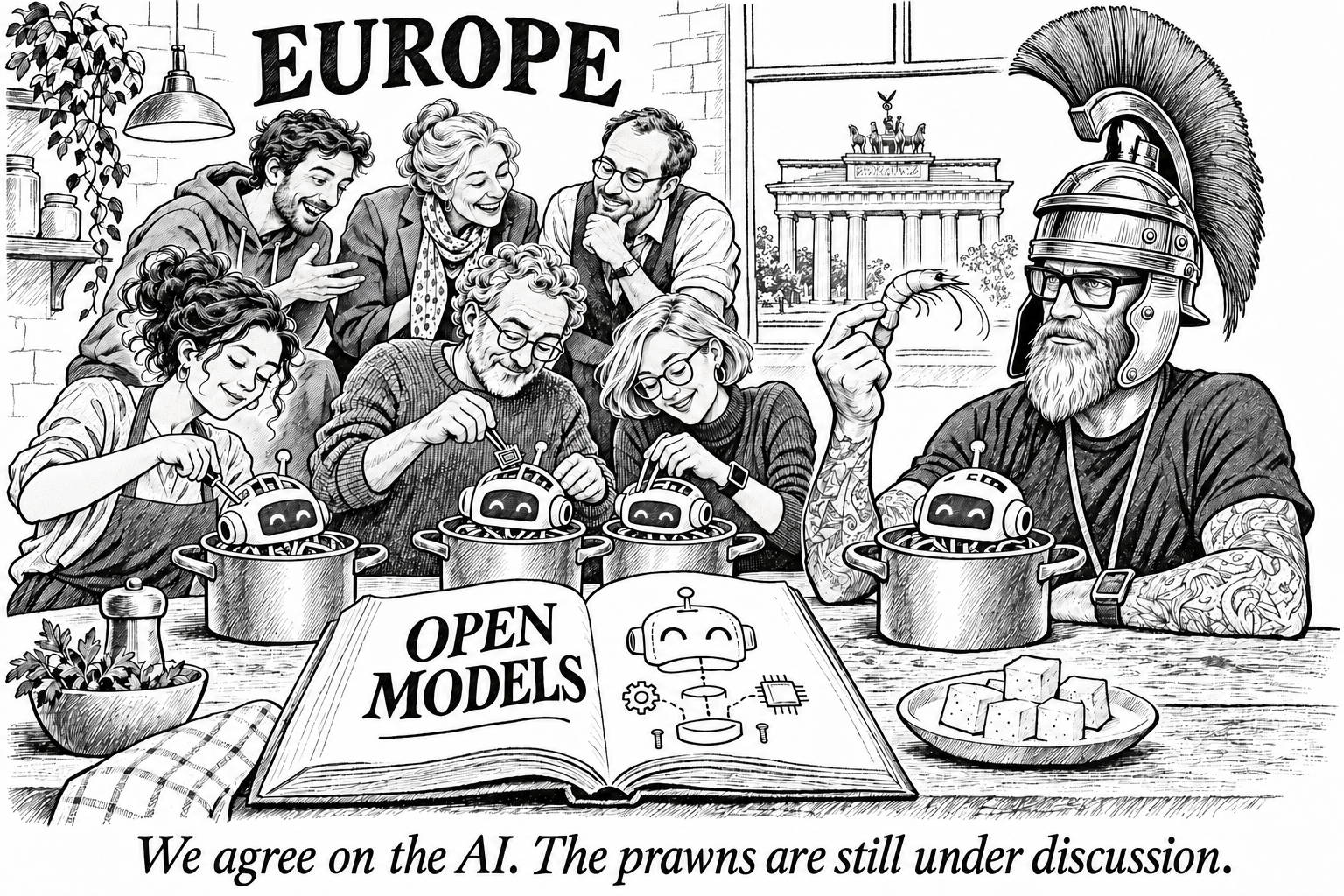
Europe wants to build AI in its own voice. That was the strongest message I brought home from GTC Berlin.
The countries have their own customs and quite different ideas about what is funny. But on sovereign AI, the conversations kept coming back to the same ambition: build the capability here, using models we can adapt, and keep a say in how it runs.
That is a fairly substantial thing to agree on. (My own contribution to the cultural discussion was a pre-trip essay involving a Roman helmet. Perhaps leave me out of the policy working group.)
What does AI in your own voice actually mean?
It means being able to shape a model around how your people work, including the things that never make it into a translated user manual.
In one conversation about Norway, the ambition was to bring Norwegian knowledge and ways of doing things into AI, including in smaller businesses. There was a practical enthusiasm for giving capable people access to open models and letting them learn what they could do with them.
That stayed with me. A Norwegian business should be able to build on its own experience. So should a French one, or a German one. The language matters, but so does the judgement behind it. What counts as a useful answer? When does somebody expect a caveat? Does the joke need explaining?
If you have to explain the joke, I suspect the localisation needs work.
Why did open models matter so much?
Open weights give people a starting point they can run and adapt, subject to the model’s licence. They can build skills around something they can work on themselves.
NVIDIA’s Berlin announcement explicitly linked its open models to customisation with local data and deployment on infrastructure organisations control. Jensen Huang put the wider ambition plainly: “you don’t want to just be consuming the AI; you want to be producing the AI”. NVIDIA’s keynote account
One explanation of NVIDIA’s blueprints was “a seventy percent recipe that you have to cook yourself”. We then got onto tofu, shrimp and whether we should be calling them prawns. You still have to choose the ingredients and do the cooking.
My read: that is why openness matters here. Local teams get something they can work on, adapt and learn to run themselves.
At Startup Day, one founder described how publishing conversational-model research and releasing the models had brought in people who wanted more specialised, polished systems. The interest helped lead to a business. Sharing the work had given prospective customers something to try, and a reason to come back to the people who understood it.
I liked that account. There was still something worth selling after the research was shared. The commercial work was in making it useful for somebody.
Who was asking for this?
Customers were asking for more control too. One European infrastructure operator told us the conversation was being started by its customers.
The same discussion acknowledged the obvious complication: much of the hardware still came from American chip companies. They were working out which dependencies they could change and which they would continue to rely on.
The smaller-business conversations were equally practical. Customers were developing use cases around their own work, with people helping them turn those into something they could deliver. Then came the question of who inside the business would own the project and pay for it.
Does control mean running everything yourself?
It did not in the operating models we discussed. One operator put its arrangement neatly: “We run it, but we don’t own it.” The customer bought or leased the infrastructure, and the operator looked after it.
Owning something and doing every job needed to keep it running are different decisions. A business can want control without wanting to recruit a team to spend its weekends looking after a server room.
Google’s Berlin announcement reflected that range of choices. It described air-gapped systems on premises, regional controls in its public cloud, and isolated cloud operated by a local independent partner.
Those arrangements need different questions. Who operates it? Who can change it? What happens if an external service disappears? Where do the prompts and logs end up?
I’ve written about custody before, and I still want those answers. But I came away with more interest in the local people and businesses being built around the technology. Having someone nearby who knows how to run the thing is useful too.
What does Europe still need to build?
People need access to compute, and the experience to use it well.
At Startup Day, one panellist described doing research in Paris while using compute clusters in the US. Having the talent locally does not automatically give it the capacity to build a model locally, or the money to keep doing it.
The inference discussion made the next part fairly plain: if you want independence, somebody has to understand how to run the model. Downloading the weights does not confer that knowledge.
Elsewhere, the discussions got into power, cooling and finance. The finance people still wanted a business case, which seemed reasonable. A large ambition does not pay the electricity bill.
The honest caveat
The conversations were encouraging. They were also at an AI conference, which is a fairly efficient way of finding people who think AI is a good idea.
I would not turn that into a claim that every European buyer agrees, or that every company has already chosen open models. Several discussions were about getting started.
In one conversation I suggested that companies were still using ChatGPT to write emails. The reply was “and then to decipher emails”.
There is some distance between that and a continent operating its own AI infrastructure. I came home enthusiastic about the direction, with no illusion that everyone was already there.
Open weights also do not tell you everything about a model’s training, and they do not make it safe by themselves. Someone still has to test it, look after it and decide what data it may read. I build data-governance software, so you were always going to get that sentence from me.
Net: I came home wanting Europe to make this work. Open models give local teams somewhere to start. They still need the skills and compute to build AI around their own work. They can sort out whose jokes are funny among themselves.
Sources
- GTC Berlin 2026: Live Updates From NVIDIA CEO Jensen Huang's Keynote · NVIDIA · 2026-10-21
- NVIDIA Open Models Advance Europe's Sovereign Intelligence Across Industries · NVIDIA · 2026-10-21
- Google Cloud and NVIDIA expand co-engineering collaboration to scale infrastructure for the agentic era · Google Cloud · 2026-10-21